Love is the most senseless of the products of the human senses. This nature of love allows it to be unconditional when there is a need for it to be. Love just like hate, does not have to be justified. The recipient does not have to deserve it. S/he is simply a recipient regardless of whether s/he feels loved. It’s possible to be in a situation where one is trying his/her best loving you [sic] but failing to make you feel loved.
Miss Sullivan, in Helen Keller’s autobiography, said: “You cannot touch the clouds, you know; but you can feel the rain and know how glad the flowers and the thirsty earth are to have it after a hot day. You cannot touch love either, but you feel the sweetness that it pours into everything. Without love, you would not be happy or want to play.”
One who gives love. Is one with a seed. One who receives feels it, opening up chances for responding positively to the love received. This is exactly what the seed begs for to spring up, grow and multiply itself through its fruits. In simpler terms, being loved and feeling that way is receiving the seed of love, giving it life instead of trying to kill it.
Love is an abstract concept whose existence is non-spatial and non-physical. Yet it has more than its fair share of influence on the very physical components of our lives. Thanks to this trait, you can’t locate it in the physical space. You can’t store it for future use. You don’t time when to give or get it for it to be love.
Picking up from Miss Sullivan’s concept, any form of physical affection is just a product of love and is not love itself. Kissing a lady in front of a camera for film production does not mean I am in love with her. If the source does not entail love in, my actions, however they may depict love, are not an expression of love.
In the Discourses of Epictetus, it is written under the topic On Friendship that, “Whoever then understand what is good can also know how to love; but he who can not distinguish good from bad, and the things which are neither good nor bad from both, how can he possess the power of loving?” This statement summarises what agape kind of love is all about. In the same paragraph the Stoic attaches this kind of love to wisdom; “to love, then, is only in the power of the wise.” This suggests that one cannot love without an understanding of the concept of love. Love is good and not bad. It gives and does not take. Wisdom is pure understanding of the method, not the result.
Søren Kierkegaard wrote in his Provocations, “For love is overjoyed when it unites equals, but it is triumphant when it makes equal that which was unequal.” Kierkegaard would then give a contrast of two artists, one who was in constant search for a perfectly beautiful woman worth the effort of his brushstrokes. The other quickly retired himself from the search citing that even his eyes were not perfect at differentiating imperfect from perfect. While the former concluded, “I have found no face with such perfection of beauty that I could make up my mind to paint it.” The latter found a starting point, “I have not found a face so insignificant or so full of faults that I could still discern in it more beautiful side and discover something glorious. Therefore I am happy with the art I practice, though I make no claim of being an artist.”
One who gives love in its truth does not have qualities they intend to find lovable in any given object they shower with love. If these qualities are to be there, they can’t be said to be unique to that object or person. Kierkegaard instructs not to be in pursuit of a lovable object/person but to find the person in front of you lovable. The world in itself cannot let you set apart lovable objects from non-lovable ones. Therefore, you have to love the one you see. Kierkegaard warns of a risk of giving up on loving one when perfections that led you to love them cease to exist.
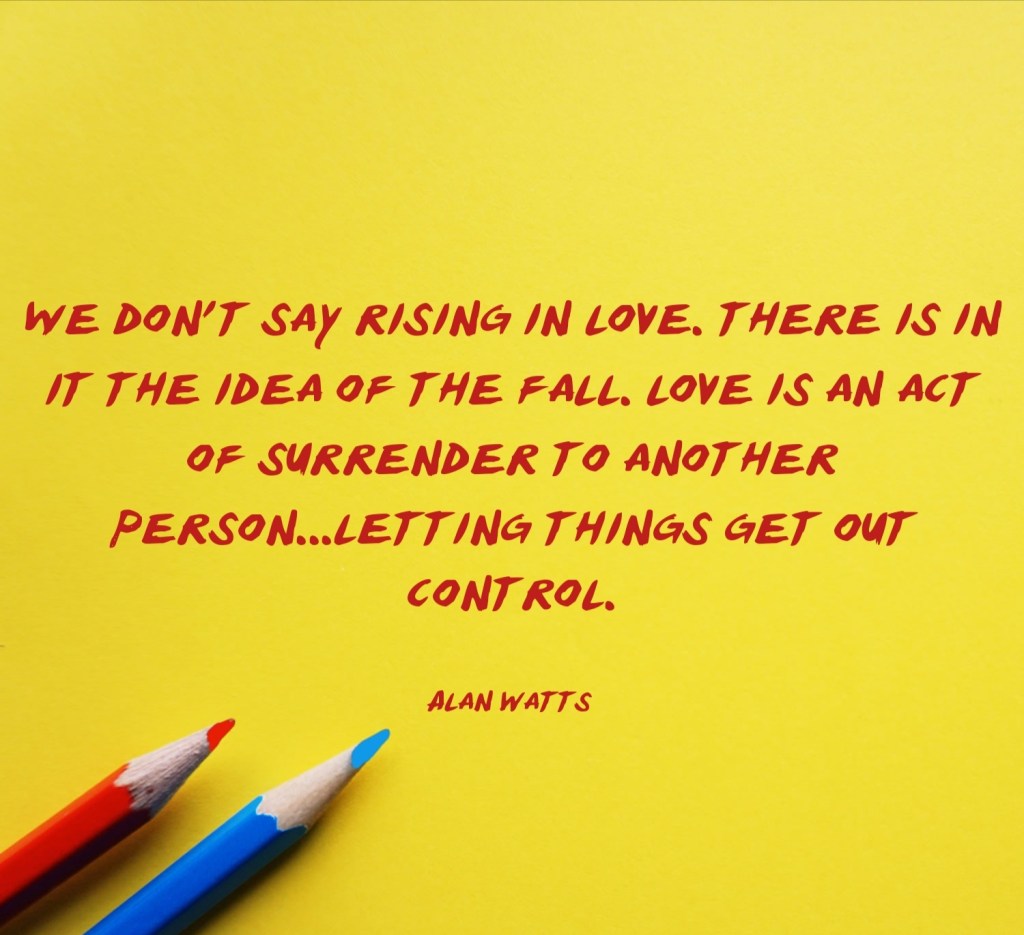
“We don’t say rising in love. There is in it the idea of the fall. Love is an act of surrender to another person…letting things get out of control.” These are the words from Alan Watts’ Divine Madness speech. They point to the impossibility of utilising sacrifice as a leading way of delivering love. Whoever is giving does so at the expense of addressing their own goals and achieving their objectives with zero anticipation of a return favour. Only in the scope of romantic love can the giver grow in strength as they get the love they put in back.




 Socien's Blog
Leave a comment